

Litoust India as discussed has been in the Indian market for the past 8+ years and we have gone from success to success in this short period of time. We do Marketing and PR for our clients, but we work with the responsibility of being their business partners.
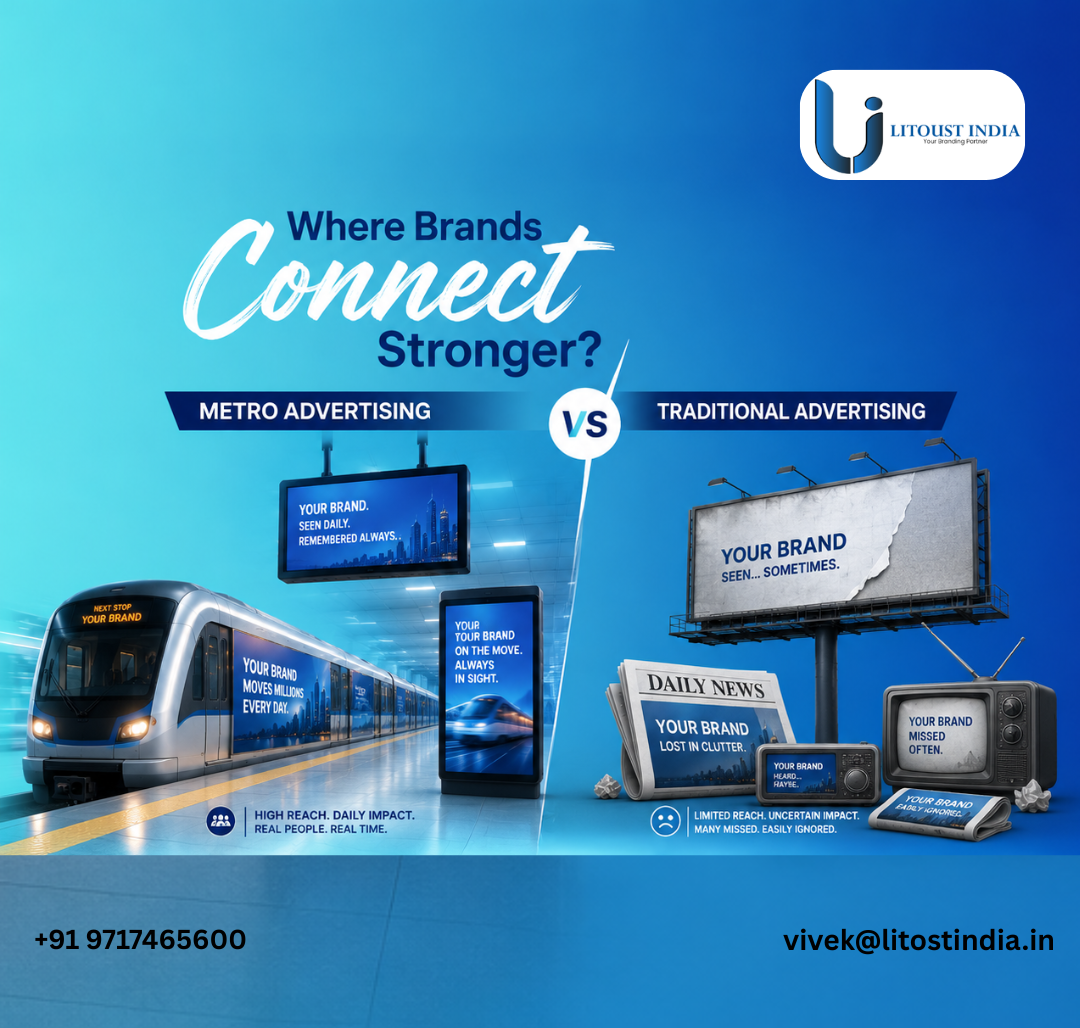
In a world where consumers are surrounded by ads every second, businesses are constantly searching for smarter ways to stand out. From television commercials and newspaper ads to digital campaigns and transit branding, every platform promises visibility. But when it comes to modern urban marketing, one strategy is rapidly taking over the spotlight — Metro Advertising.
So the big question is:
Does metro advertising actually perform better than traditional advertising?
The answer lies in how people live today.
Traditional advertising once dominated the market. Families watched TV together, newspapers were part of every morning routine, and radio ads reached millions daily.
But consumer behavior has evolved.
Today’s audience spends more time commuting, scrolling on smart phones, and interacting with visual spaces in cities. Attention spans are shorter, competition is higher, and brands need repeated visibility to stay memorable.
This is exactly where Metro Advertising creates a powerful advantage.
Metro advertising places your brand inside metro stations, train panels, entry gates, escalators, digital screens, and even full train wraps. It turns public transportation into a moving branding ecosystem.
Every day, thousands of commuters repeatedly see the same advertisement while traveling to work, college, shopping hubs, or business districts.
That repetition builds trust.
Unlike newspaper ads that disappear after one read or TV commercials people skip online, metro ads stay visible throughout the commuter journey.
Metro commuters spend several minutes inside stations and trains. This gives brands longer visibility compared to quick billboard glances or skippable digital ads.
Metro networks mainly attract city consumers — professionals, students, entrepreneurs, travelers, and families with strong purchasing power.
When a brand appears across metro stations, it naturally feels more established, trusted, and large-scale.
Repeated daily exposure creates stronger memory retention. Even if commuters don’t immediately purchase, they remember the brand when needed later.
This is why agencies like Litoust India are helping businesses use metro advertising strategically for stronger urban visibility and long-term brand recognition.
Traditional advertising isn’t completely outdated. In fact, it still works effectively in many industries.
Television advertising helps with mass awareness. Newspapers still influence certain regional and older audiences. Radio works well for local promotions and event campaigns.
But the challenge is simple:
Modern consumers are harder to hold.
Most traditional ads now compete against smart phones, streaming platforms, social media, and short-form content.
That reduces engagement.
|
Factor |
Metro Advertising |
Traditional Advertising |
|
Audience Attention |
High |
Moderate |
|
Repeated Exposure |
Excellent |
Limited |
|
Urban Reach |
Strong |
General |
|
Brand Recall |
Very High |
Average |
|
Visibility Time |
Longer |
Shorter |
|
Premium Feel |
Strong |
Depends on medium |
|
Modern Appeal |
Excellent |
Sometimes outdated |
Today, businesses don’t just want visibility — they want impact.
Metro advertising helps brands:
From startups and educational institutions to fashion brands and real estate companies, metro campaigns are becoming a major part of modern marketing strategies.
Even growing businesses now partner with agencies like Litoust India to create metro advertising campaigns that blend creativity, location targeting, and brand storytelling.
Traditional advertising still offers value, especially for broad-market campaigns. But in fast-moving cities where attention is limited and competition is intense, Metro Advertising delivers stronger engagement, better recall, and more modern brand visibility.
The future of advertising belongs to platforms people cannot simply scroll past — and metro advertising is one of them.
For brands looking to dominate urban markets, metro advertising is no longer just an option. It’s becoming the smarter move.
Metro Advertising is a form of outdoor advertising where brands promote their products or services through metro trains, stations, digital screens, pillars, escalators, and platform panels. It helps businesses reach thousands of daily urban commuters.
Yes, in many urban markets, Metro Advertising can be more effective because it provides repeated exposure, higher visibility, and better audience recall compared to newspapers, radio, or TV ads.
Industries like real estate, education, healthcare, fashion, restaurants, fintech, and e-commerce benefit greatly from Metro Advertising because it targets active city audiences with strong purchasing power.
Brands prefer Metro Advertising because metro stations experience heavy footfall every day. This helps create continuous brand exposure and improves customer trust through repeated visibility.
The cost depends on the city, ad placement, campaign duration, and branding format. However, many businesses consider it cost-effective due to its massive reach and strong branding impact.
Businesses can partner with experienced advertising agencies like Litoust India to plan, design, and execute metro advertising campaigns strategically for better visibility and ROI.