
Litoust India as discussed has been in the Indian market for the past 8+ years and we have gone from success to success in this short period of time. We do Marketing and PR for our clients, but we work with the responsibility of being their business partners.
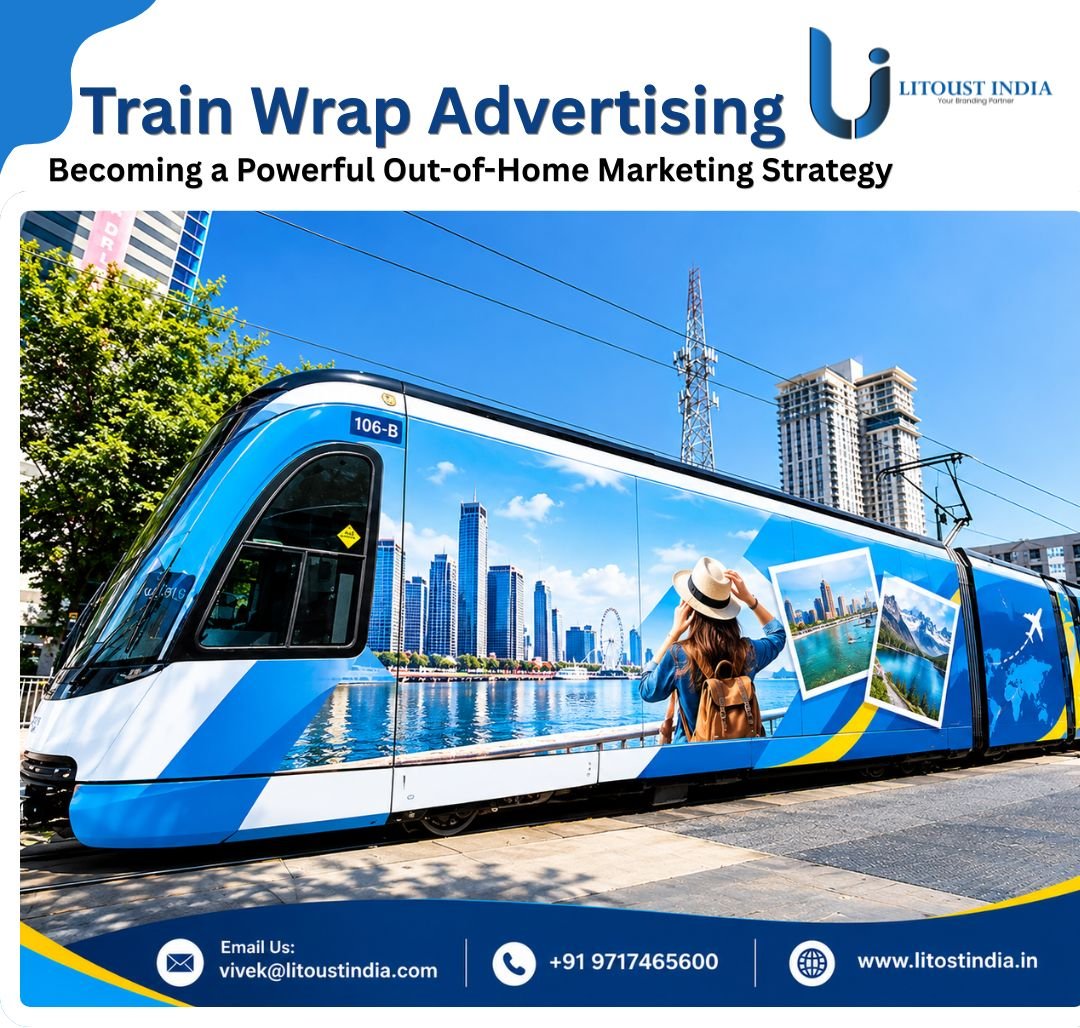
In a crowded advertising landscape, brands are constantly looking for ways to capture attention beyond digital screens and traditional billboards. Train wrap advertising has emerged as a high-visibility form of out-of-home (OOH) advertising that transforms trains into large-scale moving brand displays.
Instead of reaching audiences from a single fixed location, a branded train can travel across multiple routes, stations, neighbourhoods, and commuter touchpoints. This combination of mobility, scale, repetition, and visual impact makes train advertising an attractive option for brands looking to strengthen awareness and create memorable campaigns.
Train wrap advertising involves applying branded graphics, campaign messaging, promotional artwork, or visual identity to the exterior or selected sections of a train.
Depending on the available advertising inventory, campaigns can include:
Full train wraps
Partial exterior wraps
Door and coach branding
Interior advertising
Station and platform branding
Special promotional campaigns
A professionally designed train wrap essentially turns an everyday transportation asset into a moving billboard, allowing brands to communicate with audiences throughout a train's journey.
The growing interest in transit media comes down to one major advantage: high-visibility brand exposure in everyday environments.
Unlike online advertisements that compete with social posts, videos, notifications, and other digital content, OOH advertising exists within the physical environment. A creatively branded train can become part of a commuter's daily journey and generate repeated exposure over time.
Trains operate through areas where large numbers of people live, work, shop, and travel.
A branded train can potentially reach:
Daily commuters
Pedestrians
Road users
Passengers
Students
Tourists
Local residents
Business audiences
The large surface area also gives advertisers substantial creative space to communicate their brand.
One of the biggest advantages of train wrap advertising is mobility.
A conventional billboard communicates with audiences from one fixed location. A wrapped train can travel through different parts of a city or region, creating multiple opportunities for people to encounter the same campaign.
For brands focused on awareness, recognition, and recall, repeated physical exposure can help reinforce the campaign message.
Train wraps provide a large canvas for creative storytelling.
Brands can use bold graphics, product imagery, campaign characters, taglines, and distinctive visual elements to create an advertising experience that stands out.
A successful train wrap should do more than display a logo. It should use the available space to create a visual identity that people can understand quickly.
The success of a train wrap campaign depends not only on the creative concept but also on planning, production, media coordination, and execution.
Companies such as Litoust India can be considered when brands are looking for professional support for transit and outdoor advertising campaigns. Working with an experienced advertising partner can help businesses evaluate available media options, develop campaign creatives, coordinate production, and plan the execution according to the requirements of the selected advertising network.
For brands planning a train branding campaign, it is important to discuss the target audience, routes, campaign duration, available inventory, creative specifications, production requirements, and expected campaign objectives before finalizing the media plan.
Train wrap Branding is part of the broader OOH advertising ecosystem, but its mobile nature creates a different advertising experience.
|
Advertising Format |
Main Advantage |
|
Billboards |
Strong visibility at fixed locations |
|
Bus Advertising |
Mobile exposure across road networks |
|
Metro Advertising |
Access to urban commuters |
|
Airport Advertising |
Premium audience and high dwell time |
|
Train Wrap Advertising |
Large-scale mobile brand visibility |
|
Digital OOH |
Dynamic and frequently changing content |
The right format depends on the campaign objective, target audience, location, budget, and desired frequency of exposure.
A successful campaign starts with a strong creative idea, but execution is equally important.
People may see a moving train for only a short period. The primary message therefore needs to be understood quickly.
A strong design generally prioritizes:
Brand → Message → Visual → Call to Action
Trying to communicate too much information can reduce the impact of the campaign.
The logo, brand colours, typography, product imagery, and other distinctive elements should be easy to identify without making the design feel overcrowded.
Train advertising is different from designing a conventional billboard. The creative needs to account for:
Doors
Windows
Curved surfaces
Coach divisions
Handles and fixtures
Safety markings
Technical restrictions
A design that looks impressive on a computer screen may not work equally well when applied to the actual train.
The primary role of many OOH campaigns is not necessarily an immediate transaction. Instead, they help build brand familiarity and recognition.
When commuters repeatedly see the same branded train, the campaign can become more familiar over time. This can be particularly useful for:
Consumer brands
Automotive companies
Real estate developers
Educational institutions
Technology companies
Retail brands
Entertainment campaigns
Financial services
Tourism brands
For product launches and large awareness campaigns, train advertising can also complement digital, social media, search, television, and other marketing channels.
One of the most effective modern approaches is to connect offline advertising with online engagement.
A train campaign can include:
QR codes
Campaign hashtags
Short URLs
Promotional offers
Social media activations
Dedicated landing pages
A commuter may first discover the campaign on a train and then interact with the brand online.
This creates a bridge between physical OOH advertising and digital marketing, allowing brands to build a more connected customer journey.
Not necessarily.
Train advertising works particularly well when a campaign requires high visibility, strong visual branding, and broad audience exposure.
Before choosing this format, advertisers should consider:
Target audience
Train routes and locations
Campaign duration
Advertising inventory
Creative requirements
Production and installation costs
Expected audience exposure
Campaign objectives
Measurement approach
The advertising format should ultimately support the campaign objective rather than being selected simply because the advertising space is available.
There is no single fixed price for train wrap advertising.
Campaign costs can vary depending on:
Train network and city
Number of trains or coaches
Type of wrap
Advertising duration
Surface area
Printing and production
Installation and removal
Route and audience profile
Media-owner charges
Campaign customization
Brands should therefore request a campaign-specific quotation based on their requirements instead of relying on a generic price.
Determine whether the goal is:
Brand awareness
Product launch
Event promotion
Market expansion
Lead generation
Seasonal promotion
Brand repositioning
Understand who the campaign needs to reach and where those audiences travel.
The route, network, coach type, campaign duration, and available advertising inventory can significantly influence campaign performance.
Create artwork specifically for the train rather than simply adapting a standard billboard design.
Artwork needs to be produced using suitable materials and installed according to the advertising and transportation requirements.
Depending on the campaign, measurement can include:
Estimated impressions
Reach and frequency
QR-code scans
Website traffic
Search interest
Social media engagement
Brand-lift studies
Campaign-specific enquiries
OOH advertising is evolving as brands look for ways to combine physical visibility with digital engagement.
Train advertising is well positioned within this shift because it offers something digital advertising cannot fully replicate: a large physical brand presence in the real world.
Future campaigns are likely to focus more on creative experiences, data-informed media planning, integrated digital activations, and measurable outcomes.
Rather than treating train advertising as an isolated offline channel, brands can use it as part of a broader omnichannel marketing strategy.
Train wrap advertising is becoming a powerful OOH marketing strategy because it combines scale, mobility, visibility, and creative freedom. Instead of communicating with audiences from one fixed location, a branded train can take a campaign through multiple commuter touchpoints.
For brands looking to create memorable physical visibility, train wraps can be particularly valuable when integrated with digital campaigns and supported by a clear media strategy.
If you are planning a transit branding campaign, working with an experienced outdoor advertising partner such as Litoust India can help bring together media planning, creative execution, production, and campaign requirements in one coordinated approach.
The goal is not simply to wrap a train—it is to create a campaign that people can recognize, remember, and connect with the brand.
Train wrap advertising can provide high-visibility exposure across busy routes and commuter environments, making it particularly useful for awareness-focused campaigns.
Consumer brands, real estate companies, educational institutions, automotive companies, technology businesses, retailers, financial services, entertainment brands, and tourism businesses can all consider train advertising when their target audience aligns with the selected route and network.
Full or partial wrapping depends on the specific train network, available advertising inventory, technical requirements, and applicable regulations.
Campaign duration varies according to the advertising program and the advertiser's requirements. Short promotional campaigns and longer-term branding programs may both be possible.
Yes. QR codes, landing pages, social media campaigns, hashtags, and other digital elements can connect train advertising with online marketing.
Consider your target audience, routes, campaign objective, creative requirements, duration, available inventory, production costs, and how campaign performance will be measured.